
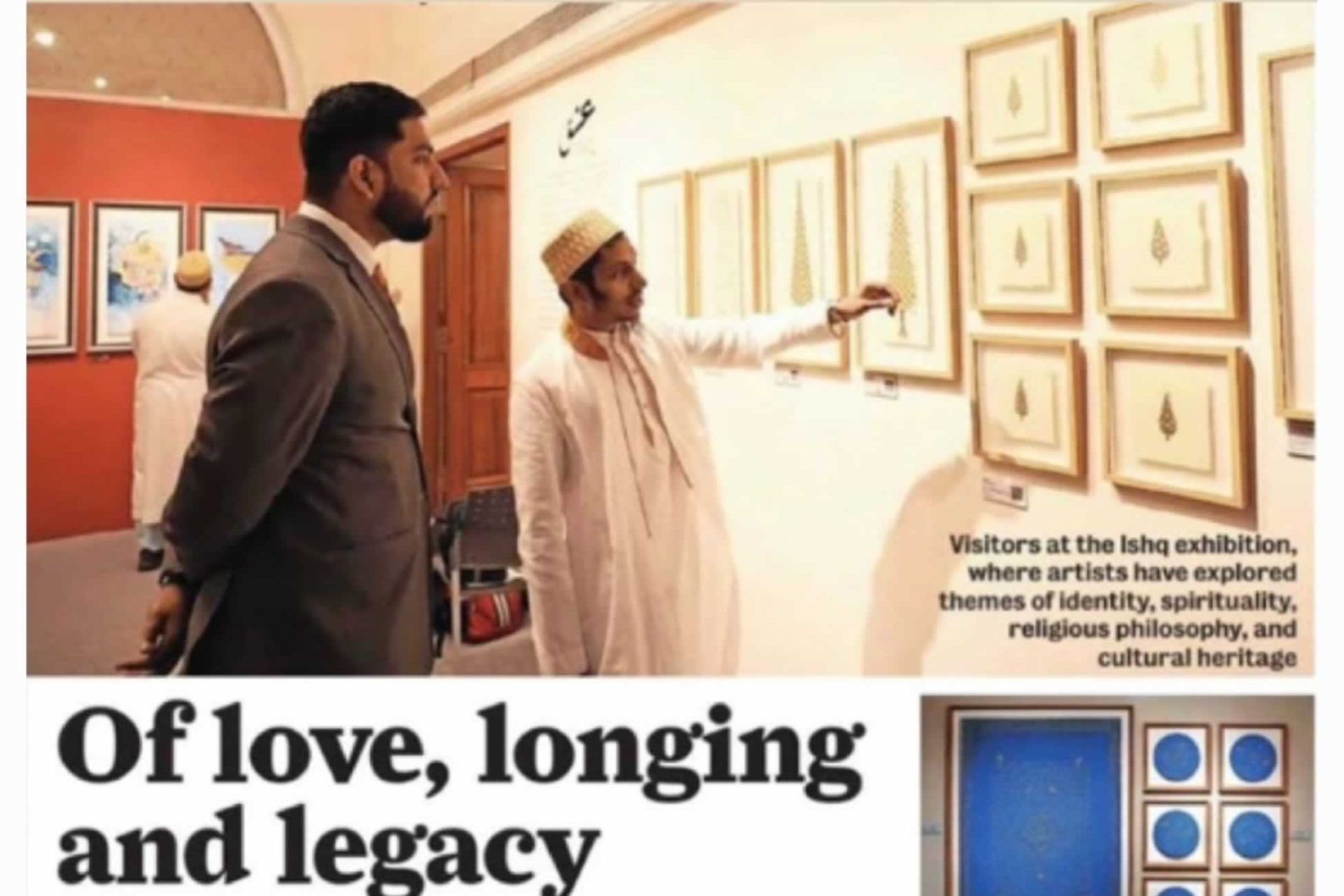

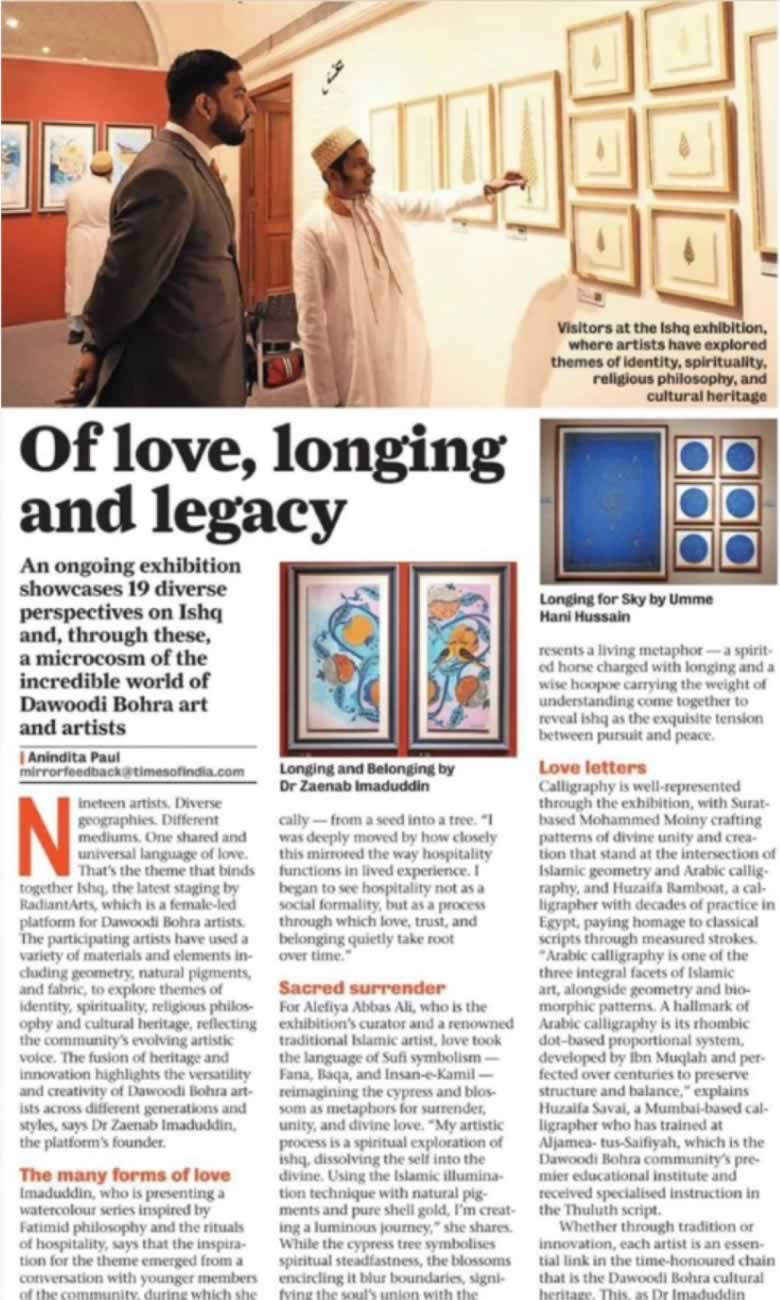
Love, in its many forms, has inspired artists across every culture and century. But Ishq: Longing, Belonging and Beyond, the exhibition by RadiantArts, approached this universal subject with a particularity and depth that set it apart. Held at Favre Leuba Hall in Badri Mahal, Fort, Mumbai, the exhibition brought together nineteen artists from different geographies and generations, each working through their own medium to ask what Ishq truly meant.
The theme, as RadiantArts founder Dr Zaenab Imaduddin explained, emerged from a conversation with younger members of the Dawoodi Bohra community. What she heard in that exchange was not restlessness but yearning, a quiet desire for connection and a sense of place. From that realization, Ishq took shape. The interpretation was left deliberately open. Artists worked with geometry, natural pigments, fabric, oil paint, calligraphy, and illumination, arriving at the theme through routes that were as varied as the works themselves.
Dr Imaduddin’s own contribution was a watercolour series rooted in Fatimid philosophy and the rituals of hospitality. Drawing on Iznik florals and traditional motifs, her works explored love not as an event but as a slow, organic process. The series was inspired by a Fatimid philosophical text that described love growing from a seed into a tree, an image she came to see as a precise description of how hospitality, trust, and belonging actually develop between people over time.
Curator and traditional Islamic artist Alefiya Abbas Ali approached the theme through Sufi symbolism, working with Fana, Baqa, and Insan-e-Kamil as her conceptual anchors. Using Islamic illumination technique with natural pigments and pure shell gold, she rendered the cypress as an emblem of spiritual steadfastness, surrounding it with blossoms that signified the dissolution of the self into the divine. Her work carried the weight of Rumi’s poetry and the philosophical framework of Wahdat al-Wujood quietly within its formal elegance.
London-based Fatema Halvadwala brought a different register to the room. Her oil painting The Story of the Sun traced the trembling outline of ishq through fallen stars, her signature layered symbolism weaving together Eastern and Western visual traditions into something altogether her own. Yemeni artist Mazher Nizar offered yet another angle: a spirited horse charged with longing and a hoopoe carrying understanding, held together in a single image that framed ishq as the tension between pursuit and stillness.
Calligraphy held a significant presence throughout the exhibition. Surat-based Mohammed Moiny worked at the intersection of Islamic geometry and Arabic script, while Huzaifa Bamboat, who trained in Egypt, paid homage to classical tradition through measured, deliberate strokes. Mumbai-based calligrapher Huzaifa Savai, trained at Aljamea-tus-Saifiyah, brought particular attention to the Thuluth script and the rhombic dot-based proportional system developed by Ibn Muqlah, which had governed Arabic calligraphy’s structure and balance for centuries.
Taken together, Ishq was not simply a themed group exhibition. It was a considered, collective act of cultural continuity. As Dr Imaduddin put it, each artist represented a living link in the Fatimid artistic tradition, one that emphasised clarity, harmony, and purpose, and that had historically been underrepresented in mainstream art discourse.
Sources:
Paul, Anindita. (2025). “Of love, longing and legacy.” Mumbai Mirror.