
ChaharBagh: Pakistani Artists Make Their Budapest Debut
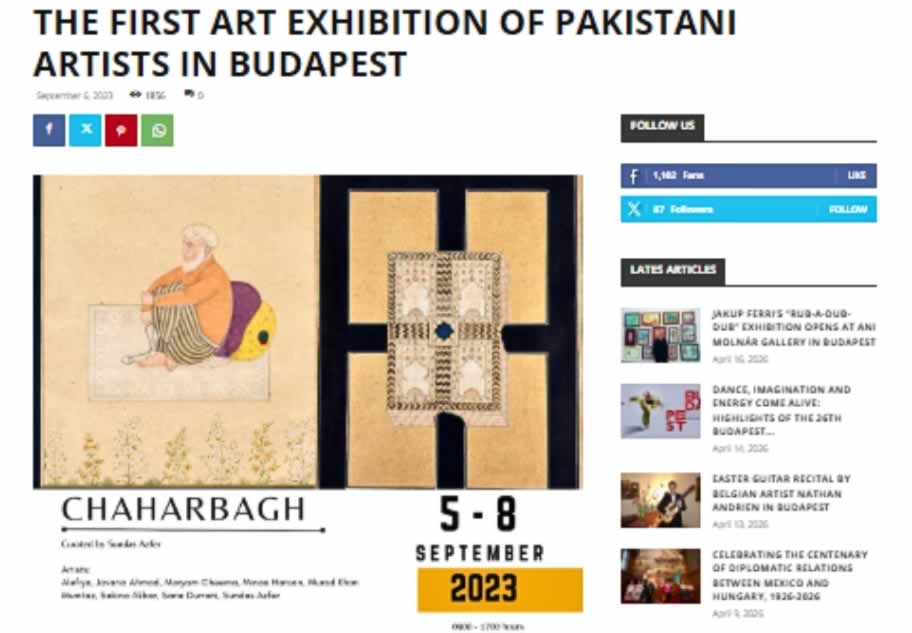
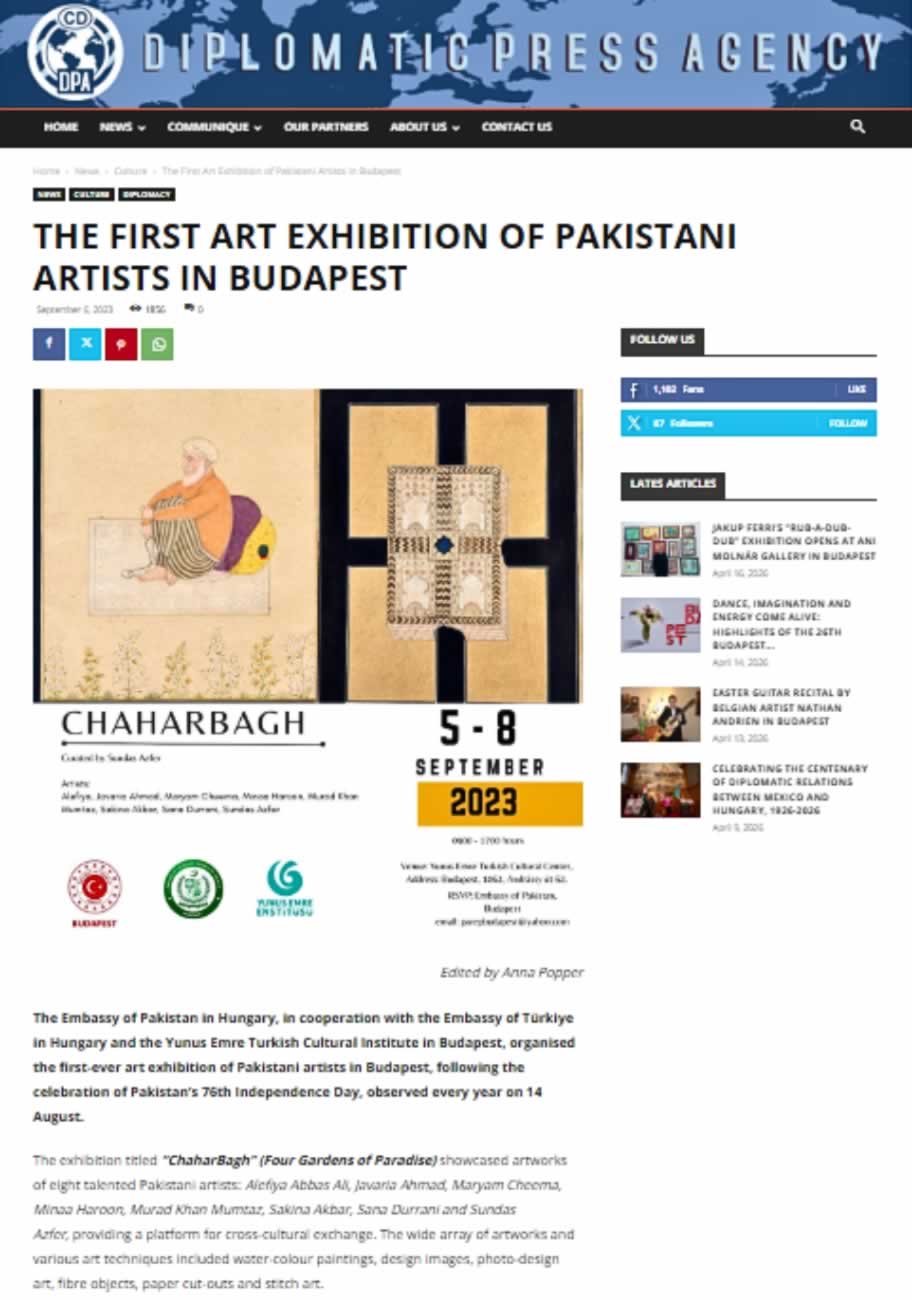
In September 2023, eight Pakistani artists brought their work to Budapest for the first time, marking a quiet but significant moment in the cultural relationship between Pakistan and Hungary. Among them was Alifiya Abbas Ali, whose practice sits at the intersection of traditional Islamic art and contemporary artistic inquiry. The exhibition, titled ChaharBagh (Four Gardens of Paradise), opened on 4 September at the Yunus Emre Institute and ran until 8 September, organised by the Embassy of Pakistan in Hungary in collaboration with the Embassy of Türkiye and the Yunus Emre Turkish Cultural Institute.
The timing was deliberate. Coming in the weeks following Pakistan’s 76th Independence Day celebrations, ChaharBagh carried both a celebratory and a more considered cultural ambition: to introduce Pakistani artistic practice to a European audience on its own terms, rooted in the country’s history, aesthetic traditions, and the depth of its artistic heritage.
The concept anchoring the exhibition was the ChaharBagh, a form with deep roots in Islamic art and architecture, historically referencing the four gardens of paradise and the geometric principles that have governed garden design, manuscript illumination, and architectural ornamentation across centuries of Muslim cultural production. It was a theme well-suited to artists whose work draws on these traditions, and one that gave the exhibition both coherence and genuine intellectual weight. Curator Sundas Azfer, addressing the opening through a recorded video message, spoke of how the concept offered a framework spacious enough to accommodate different voices while remaining grounded in Pakistan’s rich cultural heritage.
The seven other participating artists, Javaria Ahmad, Maryam Cheema, Minaa Haroon, Murad Khan Mumtaz, Sakina Akbar, Sana Durrani, and Sundas Azfer, brought an equally diverse range of mediums to the space. Watercolour paintings, design images, photo-design art, fibre objects, paper cut-outs, and stitch art filled the gallery, collectively demonstrating the breadth of contemporary Pakistani artistic practice. The works were united not by a shared style but by that shared conceptual foundation, each artist finding their own way into the theme.
The opening ceremony drew a strong and varied audience. Hungarian dignitaries, members of the diplomatic corps, art enthusiasts, students, and media representatives attended alongside the Ambassadors of Pakistan and Türkiye. Mr. Péter Jakab, Director General at Hungary’s Ministry of Foreign Affairs and Trade, served as Guest of Honour. Pakistan’s Ambassador H.E. Asif Hussain Memon used his address to advocate for more regular cultural exchange between the two countries, while Turkish Ambassador H.E. Gülşen Karanis Ekşioğlu spoke to the historic bonds between Türkiye and Pakistan and expressed support for continued joint collaboration.
That an exhibition of this kind had not happened before made ChaharBagh all the more meaningful. First appearances carry weight, and this one carried it well. For Pakistani artists working across disciplines and traditions, Budapest was not simply a new venue. It was a new conversation, and one that the city proved genuinely ready to have.
Sources