X

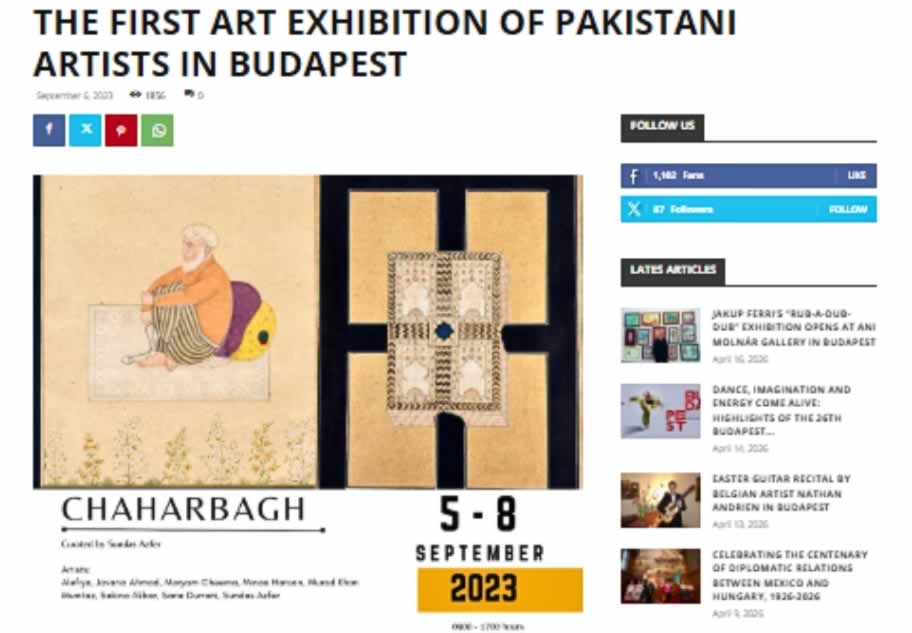
ChaharBagh: Pakistani Artists Make Their Budapest Debut

In September 2023, eight Pakistani artists brought their work to Budapest for the first time, marking a quiet but significant moment in the cultural relationship between Pakistan and Hungary. Among them was Alifiya Abbas Ali, whose practice sits at the intersection of traditional Islamic art and contemporary artistic inquiry. The exhibition, titled ChaharBagh (Four Gardens of Paradise), opened on 4 September at the Yunus Emre Institute and ran until 8 September, organised by the Embassy of Pakistan in Hungary in collaboration with the Embassy of Türkiye and the Yunus Emre Turkish Cultural Institute.

The timing was deliberate. Coming in the weeks following Pakistan’s 76th Independence Day celebrations, ChaharBagh carried both a celebratory and a more considered cultural ambition: to introduce Pakistani artistic practice to a European audience on its own terms, rooted in the country’s history, aesthetic traditions, and the depth of its artistic heritage.

The concept anchoring the exhibition was the ChaharBagh, a form with deep roots in Islamic art and architecture, historically referencing the four gardens of paradise and the geometric principles that have governed garden design, manuscript illumination, and architectural ornamentation across centuries of Muslim cultural production. It was a theme well-suited to artists whose work draws on these traditions, and one that gave the exhibition both coherence and genuine intellectual weight. Curator Sundas Azfer, addressing the opening through a recorded video message, spoke of how the concept offered a framework spacious enough to accommodate different voices while remaining grounded in Pakistan’s rich cultural heritage.

The seven other participating artists, Javaria Ahmad, Maryam Cheema, Minaa Haroon, Murad Khan Mumtaz, Sakina Akbar, Sana Durrani, and Sundas Azfer, brought an equally diverse range of mediums to the space. Watercolour paintings, design images, photo-design art, fibre objects, paper cut-outs, and stitch art filled the gallery, collectively demonstrating the breadth of contemporary Pakistani artistic practice. The works were united not by a shared style but by that shared conceptual foundation, each artist finding their own way into the theme.
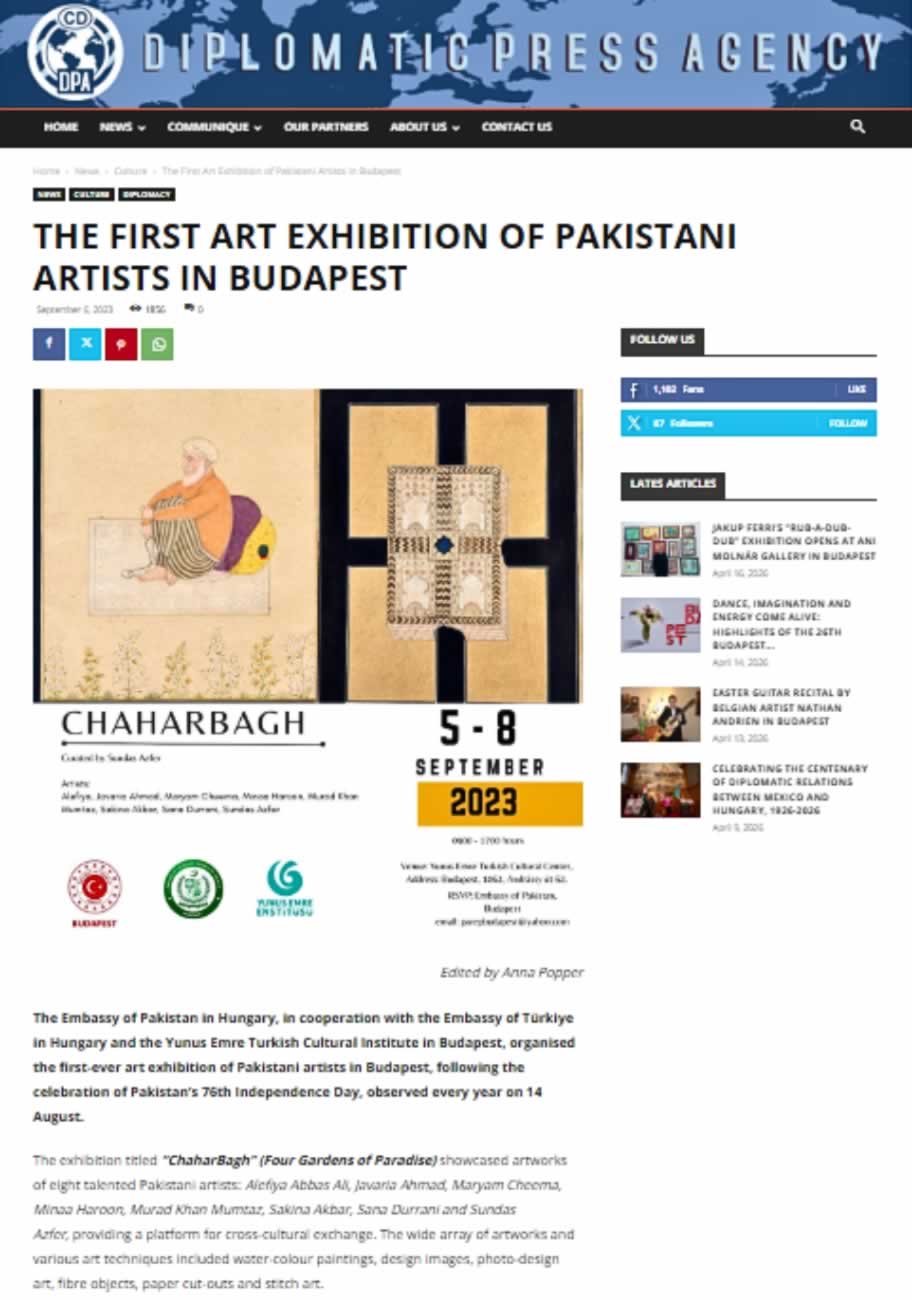
The opening ceremony drew a strong and varied audience. Hungarian dignitaries, members of the diplomatic corps, art enthusiasts, students, and media representatives attended alongside the Ambassadors of Pakistan and Türkiye. Mr. Péter Jakab, Director General at Hungary’s Ministry of Foreign Affairs and Trade, served as Guest of Honour. Pakistan’s Ambassador H.E. Asif Hussain Memon used his address to advocate for more regular cultural exchange between the two countries, while Turkish Ambassador H.E. Gülşen Karanis Ekşioğlu spoke to the historic bonds between Türkiye and Pakistan and expressed support for continued joint collaboration.

That an exhibition of this kind had not happened before made ChaharBagh all the more meaningful. First appearances carry weight, and this one carried it well. For Pakistani artists working across disciplines and traditions, Budapest was not simply a new venue. It was a new conversation, and one that the city proved genuinely ready to have.

Sources

  • Press Agency. (2023, September 6). “The first art exhibition of Pakistani artists in Budapest.” Press Agency.
Between Pursuit and Stillness: The Art of Ishq in Mumbai

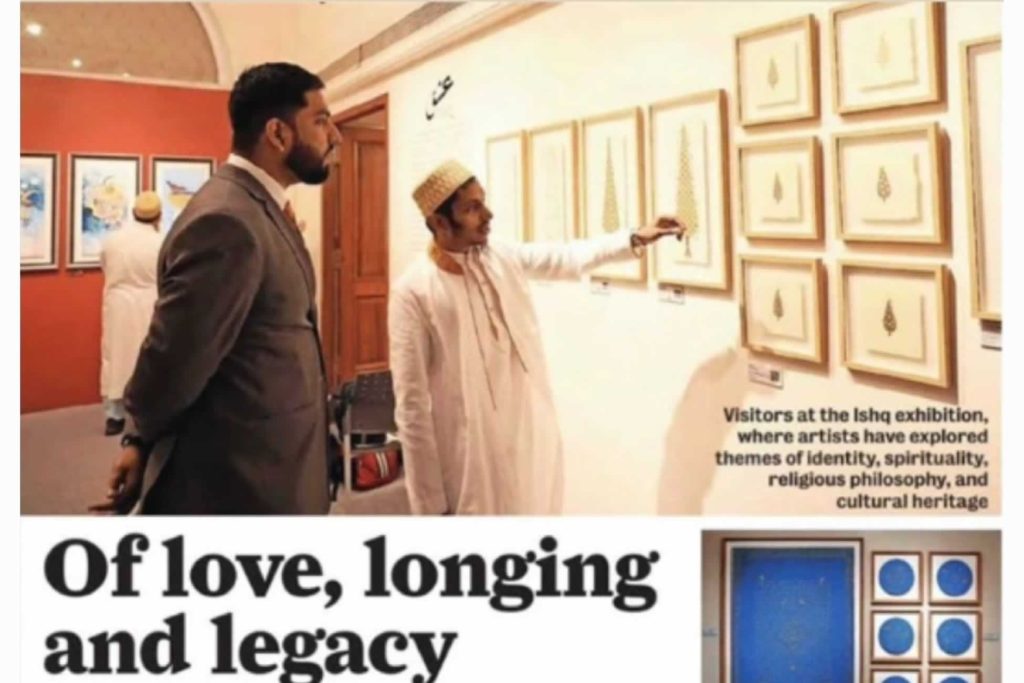
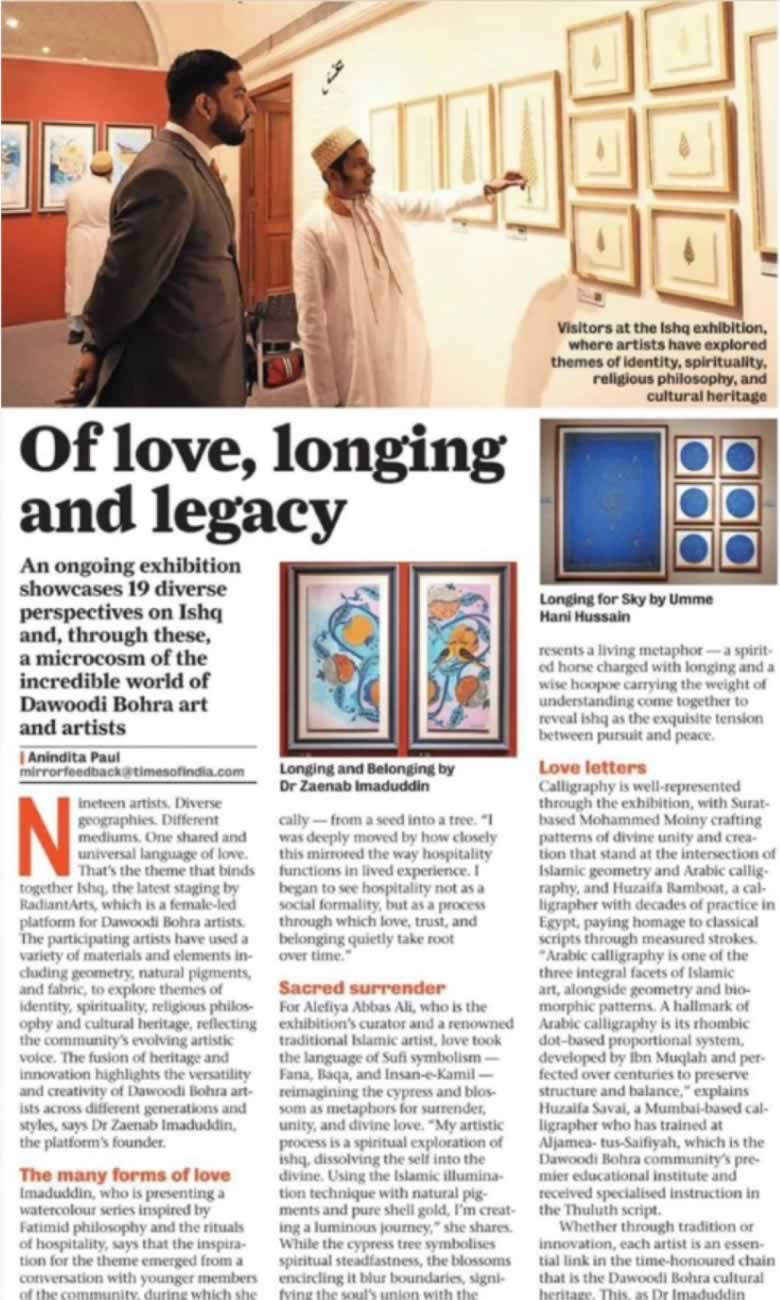
Love, in its many forms, has inspired artists across every culture and century. But Ishq: Longing, Belonging and Beyond, the exhibition by RadiantArts, approached this universal subject with a particularity and depth that set it apart. Held at Favre Leuba Hall in Badri Mahal, Fort, Mumbai, the exhibition brought together nineteen artists from different geographies and generations, each working through their own medium to ask what Ishq truly meant.

The theme, as RadiantArts founder Dr Zaenab Imaduddin explained, emerged from a conversation with younger members of the Dawoodi Bohra community. What she heard in that exchange was not restlessness but yearning, a quiet desire for connection and a sense of place. From that realization, Ishq took shape. The interpretation was left deliberately open. Artists worked with geometry, natural pigments, fabric, oil paint, calligraphy, and illumination, arriving at the theme through routes that were as varied as the works themselves.

Dr Imaduddin’s own contribution was a watercolour series rooted in Fatimid philosophy and the rituals of hospitality. Drawing on Iznik florals and traditional motifs, her works explored love not as an event but as a slow, organic process. The series was inspired by a Fatimid philosophical text that described love growing from a seed into a tree, an image she came to see as a precise description of how hospitality, trust, and belonging actually develop between people over time.

Curator and traditional Islamic artist Alefiya Abbas Ali approached the theme through Sufi symbolism, working with Fana, Baqa, and Insan-e-Kamil as her conceptual anchors. Using Islamic illumination technique with natural pigments and pure shell gold, she rendered the cypress as an emblem of spiritual steadfastness, surrounding it with blossoms that signified the dissolution of the self into the divine. Her work carried the weight of Rumi’s poetry and the philosophical framework of Wahdat al-Wujood quietly within its formal elegance. 

London-based Fatema Halvadwala brought a different register to the room. Her oil painting The Story of the Sun traced the trembling outline of ishq through fallen stars, her signature layered symbolism weaving together Eastern and Western visual traditions into something altogether her own. Yemeni artist Mazher Nizar offered yet another angle: a spirited horse charged with longing and a hoopoe carrying understanding, held together in a single image that framed ishq as the tension between pursuit and stillness.

Calligraphy held a significant presence throughout the exhibition. Surat-based Mohammed Moiny worked at the intersection of Islamic geometry and Arabic script, while Huzaifa Bamboat, who trained in Egypt, paid homage to classical tradition through measured, deliberate strokes. Mumbai-based calligrapher Huzaifa Savai, trained at Aljamea-tus-Saifiyah, brought particular attention to the Thuluth script and the rhombic dot-based proportional system developed by Ibn Muqlah, which had governed Arabic calligraphy’s structure and balance for centuries.

Taken together, Ishq was not simply a themed group exhibition. It was a considered, collective act of cultural continuity. As Dr Imaduddin put it, each artist represented a living link in the Fatimid artistic tradition, one that emphasised clarity, harmony, and purpose, and that had historically been underrepresented in mainstream art discourse. 

Sources:

  • Paul, Anindita. (2025). “Of love, longing and legacy.” Mumbai Mirror.
https://mumbaimirror.indiatimes.com/unwind/of-love-longing-and-legacy/articleshow/126290255.cms

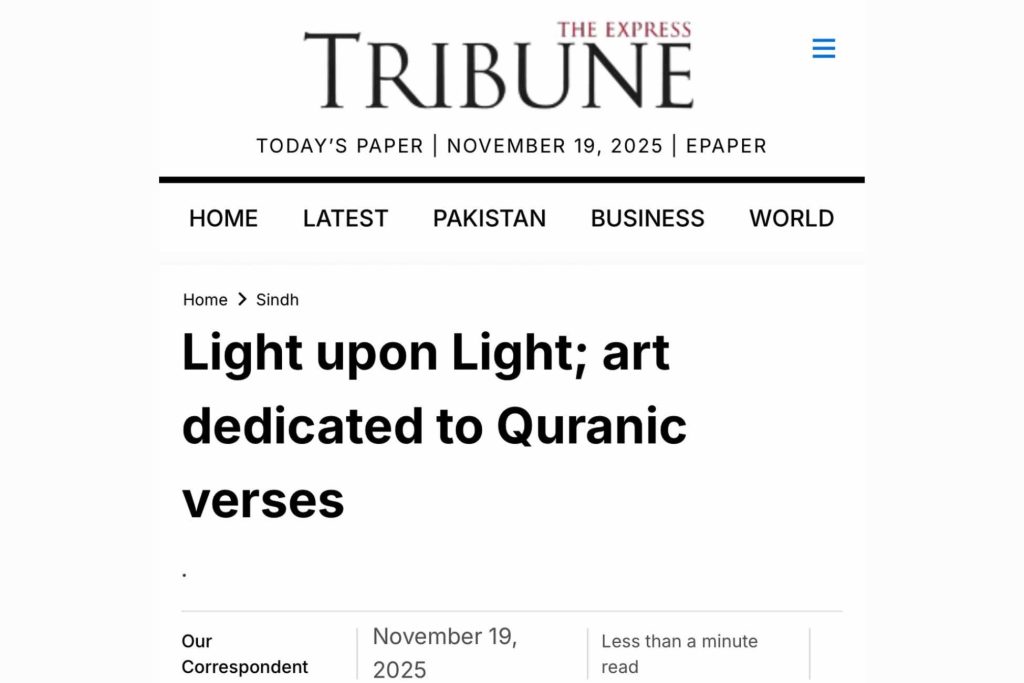
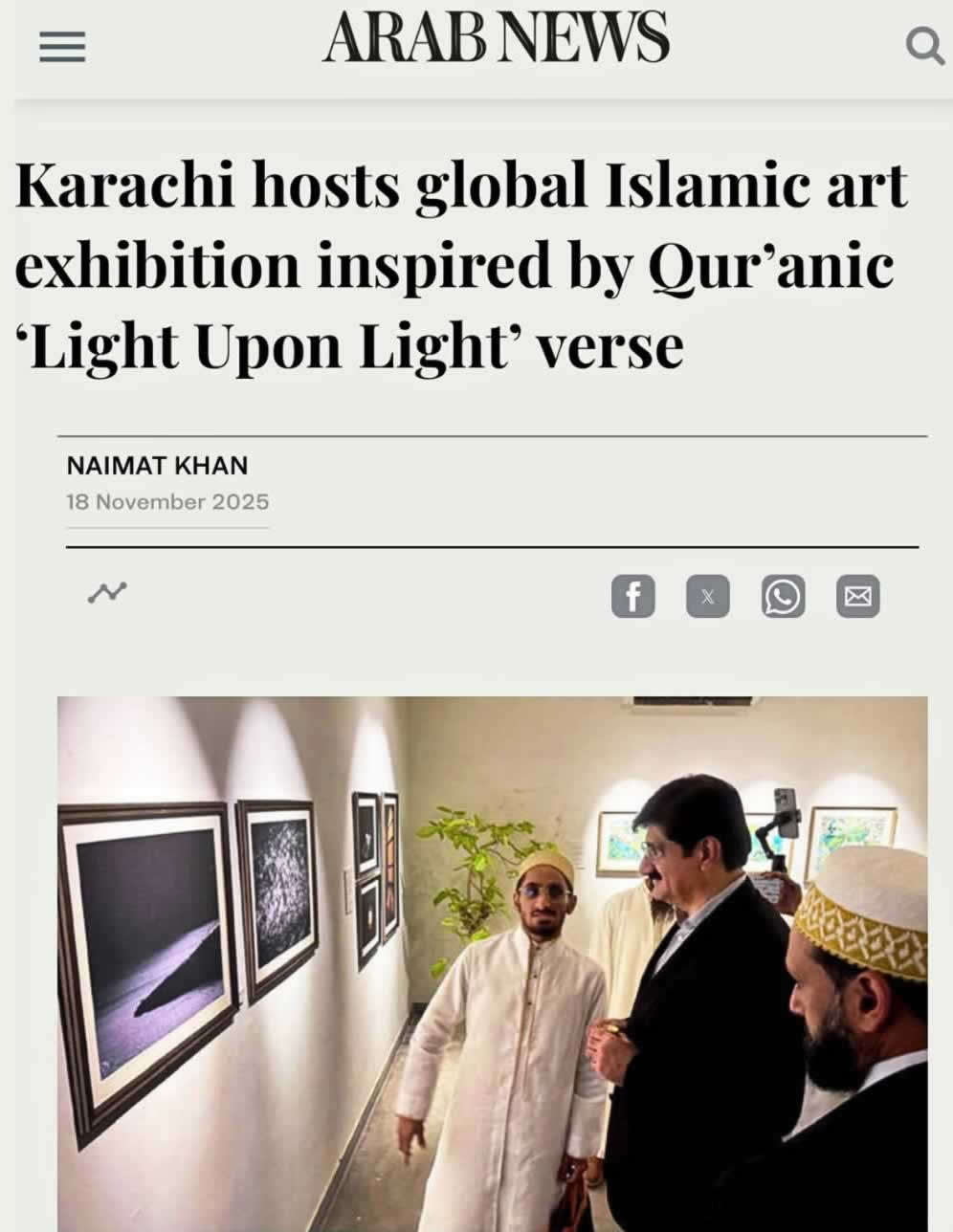
Light Upon Light: A Global Exhibition of Islamic Spiritual Art Opens in Karachi

When Karachi’s Koel Gallery opened its doors to Noorun-ala-Noor, it introduced more than just another art exhibition. This showcase directly engaged with one of Islam’s most profound metaphors: divine light as both illumination and transformation, setting a clear intent for viewers to encounter this theme throughout.

Curated by Alefiya Abbas Ali and organised under the patronage of Dawat-e-Hadiya, Light Upon Light brought together seventeen artists from across the world, each approaching the Qur’anic metaphor of divine illumination through their own visual language. Painting, calligraphy, sacred geometry, textile art, and installations filled nineteen display corners throughout the gallery, creating an experience that moved between the intimate and the monumental.

The exhibition’s spiritual core was the Verse of Light, Ayat al-Nur, drawn from Surah Al-Nur (24:35), a passage that has shaped Muslim artistic imagination for centuries. Additional works took reference from Surah Al-Baqarah (2:257), in which Allah leads believers from darkness into light, and from Surah Al-Ma’idah (5:55), whose symbolic register of radiant illumination recurred across several pieces. These were not merely textual citations. In the hands of the participating artists, they became compositional principles, guiding decisions about colour, form, geometry, and negative space. The result was a body of work that felt simultaneously rooted in classical tradition and entirely alive to the present moment.

Fatimid architectural motifs, illuminated manuscript traditions, and geometric patterning derived from centuries of Islamic decorative practice appeared throughout the exhibition, but never as nostalgic recreation. The artists engaged these visual histories with intelligence and intention, allowing historical form to carry contemporary meaning. The journey from darkness to light, Noorun Ala Noor, was not treated as a resolved destination but as an ongoing passage, one that the viewers experienced physically as they moved through the space.

The exhibition marked the first Karachi presentation by RadiantArts, known formally as Anwaar Al-Funun, a women-led, non-profit arts initiative of the Dawoodi Bohra community. Over fourteen previous exhibitions across Africa, Sri Lanka, India, and the United States, RadiantArts has built a quiet but significant reputation for presenting Islamic cultural heritage through serious, thoughtfully produced artistic programming. Sindh Chief Minister Syed Murad Ali Shah, who inaugurated the exhibition, described it as “a remarkable blend of creativity and spirituality,” adding that such initiatives strengthen social harmony and offer younger generations a meaningful connection to their heritage.

That ambition was visible throughout the exhibition, not in grand gestures, but in the accumulation of careful, considered work from artists who understood that spiritual themes demand discipline, not decoration. Light Upon Light did not reach for easy transcendence. It earned it, slowly, through the quality of its vision.

For those who believe art has a responsibility to carry meaning beyond the aesthetic, this exhibition served as a reminder of what that can look like when it is done well.

Sources:

  • The Express Tribune. (2025, November 18). “Light upon Light: Art dedicated to Quranic verses.” The Express Tribune. 
https://tribune.com.pk/story/2578087/light-upon-light-art-dedicated-to-quranic-verses
  • Arab News. (2025, November 18). “Karachi hosts global Islamic art exhibition inspired by Qur’anic ‘Light Upon Light’ verse.” Arab News Pakistan. 
https://www.arabnews.com/node/2623084/pakistan
Alif se Art Logo

Alif Se Art

Alefiya Abbas Ali is a visual artist devoted to the revival of traditional Islamic arts, reimagining sacred geometry and ornament through timeless techniques and a contemporary lens.

About Us

Alif Se Art begins with Alif, a single line and a point of origin from which form takes shape. Rooted in the traditions of Islamic art, the studio engages geometry, illumination, and pattern as practices grounded in precision, reflection, and meaning.

All Rights Reserved © 2026 Alif Se Art . Website by CUXTTerms & ConditionsPrivacy Policy

Click & Drag